6th July 2026
Process-Based Therapy at the German Psychotherapy Congress 2026 in Berlin
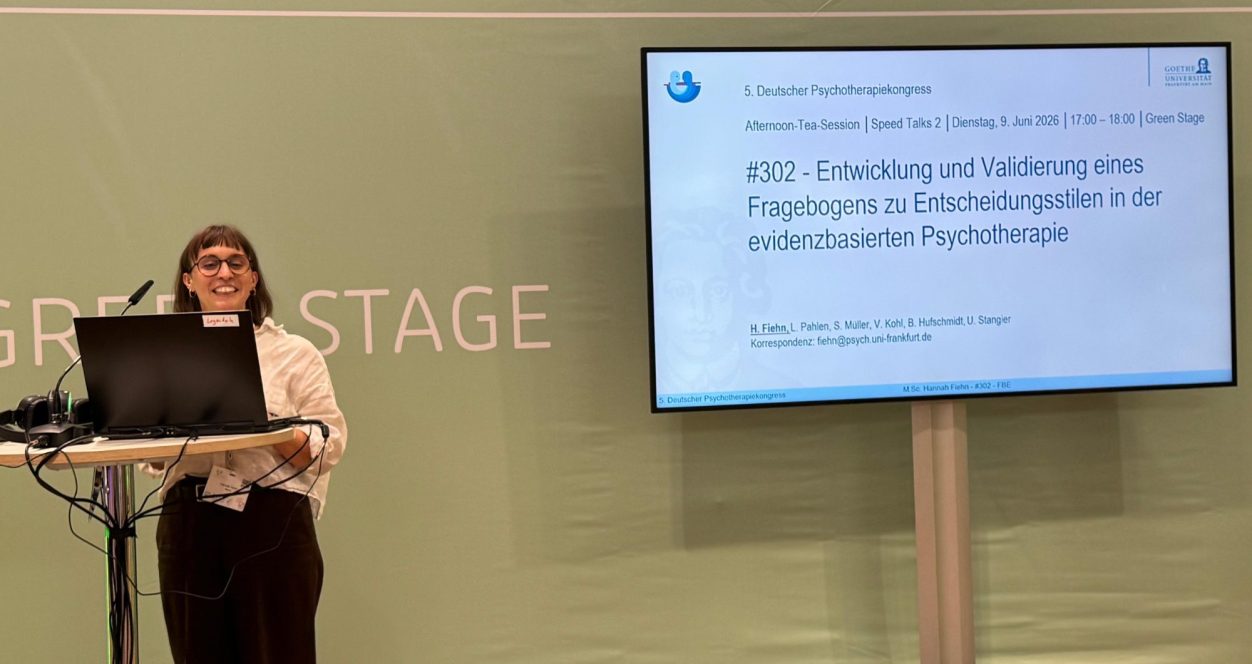
Image Description: Hannah Fiehn presenting Copyright: Franka Frischling
The Congress opened on June 9 with a workshop by Ulrich Stangier and Stefan Hofmann offering a practice-oriented introduction to process-based therapy, which is currently being investigated within the DYNAMIC project NECTAR (PIs: Stangier, Hofmann & Rief). The workshop covered the principles of therapy planning informed by dynamic network analyses of EMA data, as well as strategies for fostering positive change processes in clinical practice.
Also on June 9, Hannah Fiehn gave a short presentation on the development and validation of a questionnaire assessing decision-making styles in evidence-based psychotherapy. The measure captures a range of decision-making approaches in therapists that play a key role in case conceptualization and treatment planning - including process-based, guideline-oriented, experience-based, and intuitive styles. Simon Müller is investigating the same topic using an experimental Think Aloud paradigm, which he presented as a poster on June 10.
On June 10, Viktoria Kohl presented preliminary findings from a randomized controlled pilot study on process-based therapy at the symposium "Personalized, Data-Based Psychotherapy." The study examined the efficacy of process-based therapy in patients with treatment-resistant depression and anxiety disorders. Results suggested comparable efficacy to routine cognitive-behavioral therapy in reducing anxiety and depression, alongside markedly greater improvements in overall mental health.
On June 11, the practice symposium "From Assessment to Decision: Personalized Networks and Digital Measurement Methods in Case Conceptualization and Treatment" (Chair: Ulrich Stangier) featured two further DYNAMIC contributions. Lucie Pahlen presented findings from a feasibility study in which licensed psychotherapists implemented process-based therapy in naturalistic outpatient settings. The study found high levels of acceptance and perceived usefulness of both the network approach and EMA-based methods. Outcome patterns mirrored those of the pilot RCT: compared to control patients, process-based therapy patients showed similar reductions in anxiety and depression but significantly greater improvements in mental health. Anna Seewald presented a clinical guide for process-based treatment selection using perceived causal networks (PECANS), designed to support treatment allocation in both partial inpatient and outpatient settings. In a feasibility study, both patients and therapists rated these process-based networks as comprehensible, helpful, and clinically useful.
Taken together, these findings provide early promising evidence that a process-based therapeutic approach drawing on network models and EMA data is well accepted across a range of care settings, feasible in clinical practice, and may offer particular benefits for overall mental health beyond those achieved with routine cognitive-behavioral therapy.
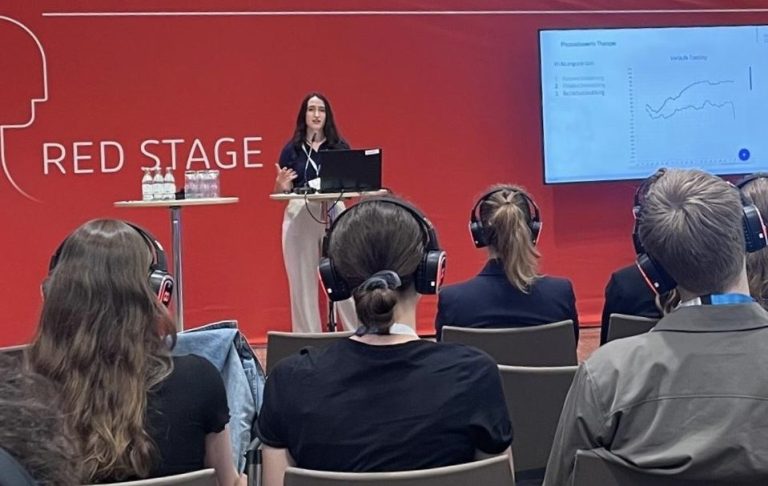
Image Description: Viktoria Kohl presenting
Urheberrechte: Lucie Pahlen